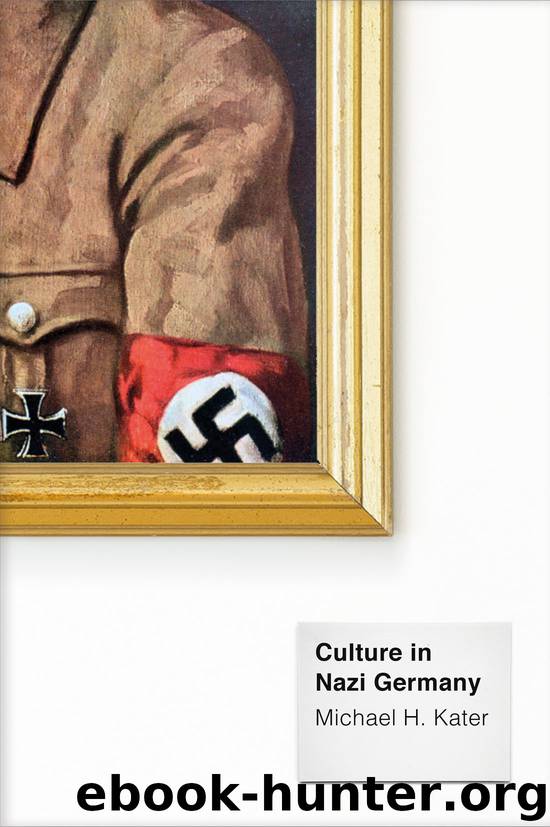
Culture in Nazi Germany by Michael H. Kater
Author:Michael H. Kater
Language: eng
Format: epub
ISBN: 9780300211412
Publisher: Yale University Press
CULTURE TO THE FRONTS
Goebbels’s utilitarian view of culture in German society and politics was nowhere more evident than at the military fronts, where there was a decline in the quality of art, music, and drama due to the wartime conditions. Irrespective of their quality, however, cultural diversions were needed as a palliative for soldiers in war.
The organizational framework for Truppenbetreuung (“Caring for the Troops”) was created in the late 1930s in a cooperation between the Wehrmacht and KdF, the “Strength-through-Joy” division of the German Labor Front (DAF) under its leader Robert Ley. It had offered up the Volksempfänger (VE; radio receiver), held out promises of a Volkswagen (KdF-Wagen), and offered workers mass entertainment and holiday cruises. At the beginning of the war the Promi joined forces with officers under Goebbels, who instructed Hans Hinkel to recruit artists and oversee a broad program of cultural recreation for military personnel and, secondarily, (German) armaments workers. On Ley’s side Bodo Lafferentz eventually officiated, an SS lieutenant colonel with a PhD in economics and later the husband of Richard Wagner’s attractive granddaughter Verena, whom Hitler, “Uncle Wolf,” always fondly called “Nickel.” The cooperation between those three administrations until 1944 was relatively smooth, except for routine differences; such as between the Promi and KdF over emoluments for the artists, with the former wanting to pay out less than the latter thought they were worth, or between the Promi and Wehrmacht, over specially established soldiers’ radio stations, whose programming Goebbels tried in vain to oversee. Ultimately, the Reich treasury, becoming rich from all kinds of robbery, including plundering artworks from occupied territories, was responsible for the overall financing.329
The raw statistics concerning these events are impressive, even if one considers that many of those who performed hardly deserved the name of artist and many performances, whatever their quality, became routine as they were repeated over and over again. From September to December 1939 alone 12,400 events were staged; throughout 1940, 137,802 performances were recorded. Until July 20, 1944, the day of the assassination attempt on Hitler, Lafferentz published in Der Angriff that 836,000 shows had been performed.330 In no other instance could Goebbels claim with greater authority not only that German culture mattered to bolster morale, but that it would be essential for a Great-German reordering after the war’s conclusion.
After registering a dearth of artist volunteers for cultural diversions at the fronts, Goebbels announced in early August 1940 that he expected all artists “to put themselves at the disposal of the great work of Truppenbetreuung, with all their hearts.”331 Indeed, artists had already been working for the program in the rearguard of troop advances both on the Eastern and Western Fronts, and then in the occupied territories such as Norway. Cologne had sent the popular Millowitsch stage ensemble to the west; the Reich Symphony Orchestra with its musicians in mustard-brown Party tuxedos had been playing Wagner, Bruckner, and Beethoven. Very well-known artists had gone on tour, among them the actors Lil Dagover and Rudolf Platte, and the musicians Hans Knappertsbusch, Rudolf Heger, Elly Ney, and Wilhelm Kempff.
Download
This site does not store any files on its server. We only index and link to content provided by other sites. Please contact the content providers to delete copyright contents if any and email us, we'll remove relevant links or contents immediately.
| Africa | Americas |
| Arctic & Antarctica | Asia |
| Australia & Oceania | Europe |
| Middle East | Russia |
| United States | World |
| Ancient Civilizations | Military |
| Historical Study & Educational Resources |
Underground: A Human History of the Worlds Beneath Our Feet by Will Hunt(12098)
Sapiens by Yuval Noah Harari(5370)
Navigation and Map Reading by K Andrew(5157)
The Sympathizer by Viet Thanh Nguyen(4390)
Barron's AP Biology by Goldberg M.S. Deborah T(4150)
5 Steps to a 5 AP U.S. History, 2010-2011 Edition (5 Steps to a 5 on the Advanced Placement Examinations Series) by Armstrong Stephen(3734)
Three Women by Lisa Taddeo(3433)
Water by Ian Miller(3187)
The Comedians: Drunks, Thieves, Scoundrels, and the History of American Comedy by Nesteroff Kliph(3079)
Drugs Unlimited by Mike Power(2594)
A Short History of Drunkenness by Forsyth Mark(2297)
DarkMarket by Misha Glenny(2212)
And the Band Played On by Randy Shilts(2209)
The House of Government by Slezkine Yuri(2206)
The Library Book by Susan Orlean(2070)
Revived (Cat Patrick) by Cat Patrick(1992)
The Woman Who Smashed Codes by Jason Fagone(1973)
The Absolutely True Diary of a Part-Time Indian by Sherman Alexie(1913)
Birth by Tina Cassidy(1905)
